
Rigid Men Break: Why Adaptability Is the Real Strength for Men
“If your identity can’t bend, your life will eventually snap.” – Brent Dowlen
Rigid Men Break: Why Adaptability Is the Real Strength for Men isn’t just a bold statement — it’s a reality most men don’t realize until something in their life fractures. Strength isn’t about clenching your fists tighter. It’s about knowing when to pivot without losing who you are.
Rigid Men Break When Strength Becomes Stubbornness
Many men pride themselves on endurance. On grit. On pushing through.
But endurance and ego are not the same thing.
You can hold the line so long that the line becomes your prison.
In this episode of the Driven 2 Thrive Broadcast, Brent walks through his own journey from a stable, respected career in enterprise IT to stepping into the uncertain world of entrepreneurship and media. The issue wasn’t difficulty. It was misalignment.
When identity calcifies, pressure builds.
The Neuroscience of Rigidity
Your brain is wired for safety.
When identity shifts, your amygdala fires. Predictability equals survival. Uncertainty feels like danger.
That doesn’t mean the new direction is wrong.
It means your nervous system prefers familiarity over growth.
Cognitive flexibility is the ability to widen that narrow threat response and build new neural pathways. It’s trainable. It’s measurable. And it determines whether you bend — or snap.
Rigid Men Break: Ego vs Alignment
Ego protects image.
Alignment protects purpose.
When you stay in a career, relationship pattern, or belief system purely because it looks strong on paper, you may be defending perception instead of pursuing growth.
Michael Jordan stepping away from basketball wasn’t logical to the world. It was aligned internally.
Dwayne Johnson didn’t cling to being “The Rock” the wrestler. He evolved into something bigger.
Mission stayed. Method evolved.
That’s the distinction.
When Rigidity Hits Your Marriage, Rigid Men Break
Career rigidity hurts you.
Relational rigidity hurts everyone.
If your wife grows and you don’t, tension builds. If you cling to the man you were 15 years ago, you stop leading — you start controlling.
Leadership requires responsiveness.
Responsive means adaptive.
The question Brent challenges men with:
“Where have I been hard to grow with?”
That’s not comfortable. But neither is slow erosion.
Rigid Men Break: Fear Disguised as Responsibility
“I’m being responsible.”
Sometimes that’s true.
Sometimes it’s fear in a suit.
There’s a difference between recklessness and recalibration. Brent makes it clear: this isn’t about quitting your job tomorrow.
It’s about evaluating whether you’re staying because it’s right — or because it’s familiar.
Short-term uncertainty feels heavier than long-term regret.
But regret compounds.
Bend Without Breaking
Rigid trees snap in storms.
Healthy trees flex.
The root system — your character, integrity, purpose — stays grounded.
The trunk moves.
That’s sustainable strength.
Flexibility is not personality-based. It’s skill-based.
You build it by:
- Challenging assumptions
- Inviting opposing perspectives
- Having uncomfortable conversations
- Asking “What if I’m wrong?”
- Making small behavioral adjustments
Start with something simple — even something as trivial as your peanut butter brand. The habit of questioning builds the muscle of adaptability.
Rigid Men Break: Final Reflection
You will outgrow jobs.
You will outgrow beliefs.
You will outgrow habits.
The question isn’t whether change will come. It’s whether you’ll fight it or train for it.
Rigid men break.
Flexible men endure.
Your mission doesn’t change. Your character doesn’t change.
But your method must evolve.
Sponsors:
MyPillow
Free MyPillow Promo Code “THRIVE” for up to 80% off your entire order at MyPillow!
Get up to 80% off EVERYTHING at MyPillow with promo code “THRIVE”! We are proudly sponsored by MyPillow offers quality products at affordable prices. Use the code for savings on sheets, pillows, slippers, and more. Shop 250+ American-made items and support both the podcast and a great company. Enjoy the comfort and savings today! 🥳 www.mypillow.com/thrive
Support our podcast:
- Support us on Patreon – https://www.patreon.com/thefallibleman
- Buy us a Coffee! https://www.buymeacoffee.com/thefallibleman
S07E07 of the Driven 2 Thrive Broadcast
Time Stamps | Rigid Men Break: Why Adaptability Is the Real Strength for Men
- 00:00:00 – Why Rigid Men Break
00:05:42 – Identity, Ego & Career Traps
00:12:18 – The Neuroscience of Resistance to Change
00:18:37 – Fear Disguised as Responsibility
00:26:10 – How Rigidity Damages Marriage
00:34:55 – Michael Jordan, The Rock & Reinvention
00:42:21 – Training Cognitive Flexibility
00:49:00 – Bend Without Breaking
DISCLAIMER: Links included in this description might be affiliate links. If you purchase a product or service with the links that I provide I may receive a small commission. There is no additional charge to you, and I appreciate your support!
Listen to the Show
Show Transcript
Rigid Men Break: Why Adaptability Is the Real Strength for Men
Brent Dowlen: [00:00:00] Rigid men break, not because they're weak, but because they confuse stubbornness with strength. You see, I used to think that strength meant sticking to the plan no matter what. 12 years in your enterprise level, IT data centers, infrastructure, stability, predictable growth, respectable career. It looks strong, but slowly.
Something just wasn't aligning anymore for me, and I had a choice. Keep griping the gripping. Keep creeping. I can't talk today. Keep gripping the identity I built, or bend a little bit. Learn to be a little more flexible. Most men don't break because life hits 'em hard. In fact, most men I know have a resilience and a perseverance that's truly admirable.
The truth is they break because they refuse to bend. When life changes direction. Think of it like a massive tree, right? [00:01:00] Part of a tree's strength is built into the fact that it's flexible. That's why we still use wood over a lot of other building materials is flexibility of the wood is actually a valuable asset If a tree can bend and sway with the weather.
Because it's healthy. Then as long as it has a strong roost to this system, it can stand for hundreds of years. And we know that, right? We all know about super old trees. We've all seen pictures of them or seen them in person. Trees that are gigantic, trees that have been around for since you know the Civil War.
The flexibility keeps the pressure off the roots and the roots give a strong, stable foundation for the tree to flex off of. But when a tree dies, it loses its flexibility, it becomes rigid, and when the storms come instead of swaying, it breaks. It uproot because it can't adapt. This is such a well-documented [00:02:00] thing that we actually use it in building construction for skyscrapers.
We understand to use certain material materials to actually make the buildings where they actually. We'll flex a little bit. There are certain kinds of, still we use just because this is such a well known thing in the world, like this is how life works. But for most of us, the pain of change isn't actually the curve ball, it's the belief that it wasn't supposed to happen.
See, we start to build this internal script, right? We graduate, we build a career, we climb, we stabilize, we win. Yay. When the script shifts, well, that restlessness creeps in the path, stops fitting. We feel like we failed the plan. It's like, no, this is the way it was supposed to work. Right? But the straight line in life, well, that [00:03:00] doesn't exist.
Not in careers, not in marriages, not in. You're calling not in your purpose. Even the strongest men I've ever studied, the strongest men I've honestly met, met all had to pivot at some point. It wasn't always predictable. Sometimes it was very sudden, but at some point they had to pivot or turn around or change completely.
They didn't abandon who they were though, they just. Adjusted how they moved, and that is the key for everything we're about to talk about is the ability to move. You see, change isn't the end all. It is even the enemy. It's a part of life. It's our ability as men to pivot a little bit, [00:04:00] maybe bend, maybe flex.
Adjust to change. That kind of gets us in trouble. Now, speaking of adjusting how you move, one of the simplest adjustments you can make in your life that pays off daily is your sleep. If you're grinding, leading, providing, building, you're sleeping on garbage, you're going to fight uphill. But if you are grinding, leading, providing, building, and you're sleeping on.
Soft, well, I won't say soft. A solid bed that is ideal for you, then you're gonna be much more fit to keep moving forward. And that's why I partner with MyPillow.
Mike Lindell: It's finally here, our second annual mega sale. This sale only comes around once a year, so take advantage of the best offers ever while you can.
For example, save 50% on our Giza Dream bed sheets as low as 29 98. And for the first time ever on tv, [00:05:00] MyPillow mattresses and MyPillow mattress stoppers as low as 99 98. And you save 50% on our Lux Pure six piece tall sets, regular 69 98, now only 39 98. And our best selling standard, my pillows regular 49 98 on sale for 1798.
Weigh on it. Mega sale only 1498. So go to mypillow.com or call the number on your screen. Use this promo code to take advantage of our second annual mega sale. But wait. There's more to make the mega sale even more special. When you order right now, your order's gonna ship absolutely free.
Brent Dowlen: That's promo code Thrive 1-800-794-FIVE 8 3 4.
The Driven 2 Thrive broadcast,
herpes growth and lasting impact for men, helping men go from living to thriving. Purpose-filled intentional lives.
Welcome to the Driven 2 Thrive [00:06:00] broadcast where men learn to lead themselves, their families, and their world with purpose, growth, and lasting impact. I'm your host, Brent, Dowlen, and let's get straight into it.
Today we're talking about something uncomfortable and that is adaptability, or more accurately why being rigid. It is a way men break and is the problem. This isn't about quitting when things go hard. Okay. You know, I would never encourage you to do that. It's about knowing the difference between endurance and ego, because that's something I've confused in my life and I'm guessing is something that a lot of men struggle with.
You see, there's a version of strength that looks impressive and there's a version of strength that actually sustains your life, and they're not necessarily the same thing. But let me take you back. See, identity is a hard thing to change. In fact, it's usually [00:07:00] the breaking point for a lot of people is we build an identity and it sticks with us and we frame ourselves that way.
When I was in in it, I wasn't unhappy because the work was hard. In fact, I was really good at my job. I was respected. My job was stable, but the identity had calcified for me. I really like cringed every time I had to say, oh, my name's Brent. I'm an IT professional. It's a job description. It wasn't really me.
It wasn't how I saw myself, and it really,
I went to work 'cause I paid the bills, but it just wasn't me. Now, there's nothing wrong with holding onto a job to take care of your responsibilities, but understand your job isn't necessarily how you [00:08:00] measure yourself. And that certainly wasn't how I measure, measure myself. That's why pivoting felt dangerous, because changing direction.
It messed with that identity. And whether I liked him, it or not, I didn't see myself that way. The identity it gave me was stable, secure. Professional, respectable provider, like it was good.
Changing directions was rough because along with
that came a lot of risk. You see under stress, your brain starts to default to rigid of thinking. The [00:09:00] mandala activates the threat. Response kicks in, and cognitive flexibility. Flexibility, if I can say the word narrows, your brain prefers predictability because predictability is safe. So when something disrupts your identity, even if it's growth, your brain interprets it as a threat.
You don't feel fear because the new direction is necessarily wrong. You feel fear because your brain hates uncertainty, and that's your brain's whole job, honestly, is to reach a state of homeostasis. This is our identity. This is our normal. This is safe and secure. This, this makes everything okay as long as we stay right here in this little box.
But it's really easy to start to become discontent if the way you see yourself, this little box is [00:10:00] part of it, but you also see that you're more than that, and if you start wanting to step out of there if, if this is only part of your identity. Like I said, there's nothing wrong with this. This was a good identity.
This was safe, this was secure. Let's put food on my table and paid my bills and allowed me to take care of my family. There was nothing wrong with this fight identity. It just wasn't making me whole. Marcus Israelis often wrote about adapting to what is given rather than demanding reality. Conform to preference, he didn't.
Control becoming emperor. He controlled how he responded to becoming emperor. See, there's a difference there, and that's strength. It's not controlling the total situation, it's controlling your response to the situation.
I [00:11:00] was in control of this situation, but my response to this situation started to degradate to being in this box to being that IT guy. My response to it started to degradate. Degradate, is that the right word? I think so, because it just wasn't making me complete. There was so much more that I wanted. So ask yourself, is your resistance logical?
Are neurological, are you fighting it because the idea's wrong or unhealthy, or is it just. Different and stepping out of the norm when you feel defensive about change, pause it. Name it. Your brain wants safety. It doesn't mean it's the wrong direction. My brain wanted security. Going a different direction wasn't necessarily wrong.[00:12:00]
It just wasn't necessarily a safe. Create space before reacting to things. That space is where that flexibility lives. And if your identity can't bend, then your life will eventually snap under the pressure. And that was the other key component, was I was already starting to fracture under that identity because it wasn't the whole of me, it wasn't the direction I wanted to be going.
It wasn't enough. To just be able to check the boxes. I wanted to live, I wanted to live my life very meaningfully, and so I started exploring change. It lit up my brain guys with everything because it risked so much security. But when your identity stiffens, we start protecting. [00:13:00] Image in our head instead of pursuing alignment, and that's where ego steps in.
Gotta grab some coffee.
You see, ego protects image non-alignment. When I started feeling pulled away from it towards building something different, the lattice voice in my head wasn't wisdom, it was image. What will people think? How will they react? I mean, you've spent multiple years in this field building a positive, uh, reputation, building credibility, climbing up in a positive direction, moving up the food chain.
Oh no, this looks unsustainable. Yeah, that definitely went through my head. Oh. Or you know, it's irresponsible to pivot mid-career. [00:14:00] Yeah, that one was rough. It wasn't logic, it was ego protecting the version of me that looked strong on paper, that looked successful. And Proverbs were told that pride goes before destruction.
Not because pride is loud, but because pride resists correction. When your plans become your identity, you stop evaluating whether all of it still serves your purpose. You just start defending it. In fact, this is a very common issue, is we hold onto something because it's become part of who we see ourselves as.
Without ever stopping the question, does this ideal, does this belief, does this thought, does this image actually serve me anymore or am I just hoarding it? Because letting it go is [00:15:00] scary. Let's look at someone like Michael Jordan. Now, Michael Jordan left basketball at the height of his dominance to play baseball.
You don't ever have had to see, had to have seen Michael Jordan play basketball to know who Michael Jordan is. If you're a basketball fan. If you're not a basketball fan, Michael Jordan is the goat. He was the greatest player of all time dot period. Some people will try and argue with me about some modern guys like LeBron.
They're full of shit. They don't know. Michael Jordan was the king of basketball, quite honestly. Likely the greatest player that has ever lived. There's been some really good players. Not knocking LeBron, but Jordan's the goat. His move to baseball wasn't linear. It didn't make any sense to anybody else. It wasn't clean.
It certainly wasn't applauded or appreciated by everybody. There were a lot of [00:16:00] pissed off people, but it was aligned with where he was internally going at the moment. It was a move he needed to make. That made no sense, absolutely no sense to anybody else in the world. Why do you walk away from being at the very top of the game at the height of your glory to go do something that quite honestly, he wasn't very good at.
It's where he wanted to go. It's who he needed to be at the moment. It's the direction his life needed to go, and it made no sense to anybody else. Now, Jordan did return to basketball. He returned stronger, not because he never left, but because he wasn't afraid to step away from an image. So Jordan knew who he was.
He didn't need the world to tell [00:17:00] him because Jordan's. Identity wasn't locked in the fact that he was a basketball player. Jordan's identity was locked in who he was. He didn't need basketball to tell him that. He didn't need fans to tell him that he knew who he was. He knew who he wanted to be, and he knew where he was going.
He stepped away from an image. We all knew him as Jordan, the basketball player. He needed to be Jordan, the baseball player for a while. Nothing wrong with it. A lot of people thought it was insane, but it was his life and it's what he needed to do for him. So let me ask you, are you staying somewhere?
Whether that's. A job or with a group of friends are trapped in something [00:18:00] you do? Are you staying because it's right or because it protects how you look? Because it is safe, because it is what is expected by your own ego. Write down the honest answer and then ask yourself if no one judged you based on the next move you made.
Right? If you could make this move without any kind of judgment, what would you do without any kind of pressure from anybody else? What would you do if it was entirely on what you feel like you need to do? Ego doesn't just protect image, it also disguises fear as responsibility. A lot of men get stuck there.
I did for years. You see fear off of masquerades as responsibility. I'm a [00:19:00] husband, I'm a father, I'm a provider. When the pool to pivot showed up, it didn't come with a safety net. It came with huge amounts of risk and fear, of course, dresses itself up as wisdom. Wait a minute. You can't destabilize things.
You worked so hard to get here. You can't risk this. Real leadership means stability. Don't rock the boat. Don't take risk. You've finally gotten, you've like, you've arrived at a place, took you years to get, and it's safe, and is stable and is giving you everything that you thought you wanted.
Luckily for me, I had been in this exact place before in another career in that profession. I actually ended up getting fired. Uh, funny story, but I won't bother to tell it today. I actually ended up getting fired and it was the best thing that actually ever happened to me. I was there for [00:20:00] two years. I hated the job.
I hated the job. I was miserable. I hated the place I worked. I hated what I do did. I did not want to be there. I stayed because it was safe. I stayed because it was stable and it was secure, and it was the responsible thing to do.
It is the only time I ever shook the hand of a man who fired me. I was too afraid to walk away even though I was miserable because I was being responsible. Now, let's be clear. Recklessness is not courage, not, I'm not encouraging you to walk away and be utterly reckless, but stagnation isn't courage either.
Your brain overestimates short-term risk. Versus long-term regret, [00:21:00] which is actually much heavier going to a lot of funerals throughout my life.
I've listened to a lot of regret, usually before the funeral, listening to people talk about what they wish they had done in their lives as they got closer to death.
Immediate uncertainty. It feels really heavy. Like really, like it weighs you down that short-term risk, the uncertainty, it's, it's, it grinds at you and it feels horrible and it stresses you out. And we weigh that heavier than looking and thinking in a long-term fashion of. At the end, what will I have wish I had done?
Will I wish I had asked that [00:22:00] girl out? Will I wish I had asked her to coffee? Will I wish I had tried that business? Will I have wish I had moved to that place? I have a friend right now who made a big shift, recently moved away from the area he's been at for years. He took a chance. It wasn't the biggest re risk.
He can still work for the same company, thankfully, 'cause he works remote. But it was a big risk. He moved away from everything he's ever known.
It hasn't gone perfectly. But what would the weight be like at the end of life if he had looked back and not taken the risk? Gone. I wish I had at least tried. We don't think long-term enough sometimes, and [00:23:00] immediate uncertainty feels a lot heavier than slow erosion. So you tell yourself to stay, not because it's right, but because it's familiar.
Stoics taught us that cleaned comfort isn't actually healthy. They taught us about choosing virtue over fear. Courage isn't loud, it's often quiet, recalibration. It's choosing who do I wanna become? It's contemplating where and what is more important, what has more value, and letting that win over fear.
Run this filter in the next five years. Will I regret trying fill in the blank or in the next five years will I regret never moving? [00:24:00] That was the question my friend had. Write down though the answer. Think farther out than you normally do and let future you have a vote. Let the person who's gonna actually live that timeline have a vote, think forward.
But let's take this into another part of your life. You see, when rigidity stays inside, your career at least feels contained. But what about when it seeps into your relationship, how that can be pretty destructive.
Oh, regimen. Men don't just break themselves. They actually fracture their homes. See, let's, let's stop pretending. This is just about career pivots. Rigidity actually shows up in your home first, when you refuse to adapt, when you clinging to an [00:25:00] outdated version of yourself, when you resist growth. Well, your wife actually fills it before you do.
Your kids experience it before you're ready to admit it. A lot of times, misalignment leaks. It leaks into tone, into your patience, into your presence, into the way you respond to things. You don't wake up one day and decide, Hey, I wanna be distant. Like, I'm just, I'm done being present. I'm, I'm gonna just drift.
You slowly calcify too many people saying she's not the woman I fell in love with. Ah, it's been 15 years. I sure as hell hope not. She changed. You changed, but did you grow together or have you been rigid? And while she grew, you stayed the exact same person you were 15 years ago. That's not [00:26:00] healthy.
That's not her fault. That's on you. Ephesians calls men to love their wives as Christ Love the church. That's sacrificially, that's attentively. That's actively, it's not passive leadership. That's responsive Leadership. Responsive means adaptive. AKA flexibility. If your wife grows and you don't, jt uh, problems.
If your marriage enters a new season and you freeze the old script, uh, problems, that's not you leading, you're crushing your marriage. For the sake of being comfortable of staying in the status quo, of staying right there in that box, the same box you started in [00:27:00] will not be the same box you end in in a healthy marriage.
My wife and I have been married for 24 years, getting close to 25. We are not the same people we were when we got married. She's not the exact same woman she was when she said I do, and I'm not the same man. We've grown together and there have been times where it was rough. There have been times it was rough because I was comfortable where I was at ego image and it was entirely my fault because I was tied to this image in my, that was protecting my ego.
You're going to grow as a couple. You're going to grow as a person. We already said stagnation. That's not natural nor healthy. If you're really brave, I've got something for you to [00:28:00] work with here. Ask your wife this question. Don't, don't make it. Don't make it a qui pro quo. Don't ask her. Be like, Hey, I'm gonna ask you this and then you're gonna ask me this.
This is not a way to start an argument or to say something nasty to your spouse. Please do not use my podcast as an excuse for that crap. Ever. Ask your wife this question though, if you're really, really ready to grow. Where have I been hard to grow with? Just listen. Don't defend yourself. Don't protest.
Don't push back, and certainly don't try and turn on her because you will squirm. 'cause if that question's gonna make you uncomfortable, good, good. You should be. Leadership that won. Adapts becomes control and control always erodes connection. [00:29:00] When rigidity touches your marriage, it exposes something much deeper.
It exposes whether your mission is actually intact or whether you've confused the method with the meaning. I'm not a believer in evolution in the Darwin concept, but evolution does exist. Everything evolves. I told you, I'm not the same man who married my wife. She's not the same woman who married me. We are young kids and we've grown a lot in the last almost 25 years.
But I mean, microevolution exists everywhere. That's just a fact. You're going to evolve as a person. That's where this flexibility comes in. We're coming full circle here. The first time I introduced myself as a podcaster was a crazy moment for me. It was a huge identity shift. My identity had finally evolved and I was no longer Brent, the IT dude.
I used [00:30:00] to introduce myself to people. I'd be like, Hey, yeah, my name is Brent. Oh, I am a, I think I was a senior associate system technician. I think that was my official company title. And, and the inevitable question was, what does that mean? And my joke was, well, that's why I get paid. Well, 'cause nobody actually knows.
Right? If I was trying to avoid further conversation, I was just like, oh, my name's Brent. I, I work in enterprise. I it, which still got some questions, but it was easier to explain. The first time I said, hi, oh, my name's parent. I'm a podcaster. It was like I stunned myself, like I actually glitched a little bit.
I had been so [00:31:00] uncomfortable and so scared that it took a couple years after I left it for me to actually call myself a podcaster. Or whatever you want to call me, even though I was doing it full-time, even though that's what I did for a living, it took me a few years because taking a leap is scary, and change is scary.
It's uncomfortable. It's going to make you uncomfortable. There's no shame in that. You're not doing anything wrong. It's not. You're not less of a man if you're uncomfortable because change is uncomfortable. Everybody thinks change is uncomfortable. This change was huge for us. There's no financial security
in what I do. There was no financial security after investing. All we had. To pursue this business. There was no parachute anymore. Everything we ever [00:32:00] put back, we put into this business, and there have been times when it's paid the bills and there have been times when it's not. It's finicky and unstable at the best, and I've worked a lot of side jobs and so has my wife and the evolution still continues.
It's uncomfortable. There are days almost every day where I question every decision I made in the last six years. There are days almost every day where I long for the security of that consistent, stable paycheck that paid our bills.
It's scary when you take a chance. It is scary when you deviate from the way you have seen yourself for years when you change identities, but change is a natural state in life. While stagnation, [00:33:00] the only natural role stagnation has in life is death. Stagnation is utterly associated with death and nothing else.
We know that stagnant water is bad. Uh, I, I see those videos all over social media now of people talking about, uh, still water stagnation is bad. It is death in every form. I'm not telling you to quit your safe job. I'm not asking you to give up a stable job, I'm sure as hell not saying, walk away from your marriage.
Don't get any of this twisted. I'm saying that you'll grow and evolve as a person in every facet of your life. So you need to learn to bend without breaking and embrace some flexibility somewhere along the way. Someone told you once that you were on your path, that was it. It was probably the same idiot who told you your wife would be the same person in 15 years.
That always [00:34:00] just kills me. Sorry, this pet peeve. People change careers change, situations change. You change, and most of us kick and scream loudly instead of flexing like a tree. Your core identity is not what you do to make money. That's how a lot of men identify themselves. But it's not your core identity.
Your core identity is your character. It's your integrity, it's your purpose, it's your foundational beliefs. Nothing that changes outside of you. Changes that you can short circuit, years of prosperity and joy by refusing to be flexible and bend with the storms. You will outgrow jobs, you'll outgrow towns, areas, other people, old friends, old ideas, concepts, dreams.
Habits, things you've cherished for years and beliefs. [00:35:00] You will absolutely outgrow them, and if you don't let them go, the cost is steep. Look at someone like Dwayne Johnson, AKA, the Rock. Most of you guys know his name is Dwayne Johnson now, but he's tried to separate that out. But all of you know the rock from college football to professional wrestling, to Hollywood to business owner.
His identity wasn't football player. His identity wasn't wrestler. His identity was in who he is, and he was a performer and he knew it. He's a builder, he's a leader. He's grown at every turn. Professionally, personally, tried to be a better person, tried to give more to the world, tried to expand what he was doing.
He [00:36:00] understands that part of who his character is. He's a performer, he's a builder. He's a leader. His mission stayed, his path evolved. Try this, write, write this down for me. Who am I and what is my actual mission? Not my job title, not the platform. I've been on lots of platforms. I'm on lots of platforms, not the business model.
My business model's currently evolving even as we speak, quite literally. So what is my core? Who am I? What is my actual mission? Once that's clear. You can start to pivot without losing yourself. If your purpose depends on your job title, it was never actually a purpose.
Pivoting as long as you keep to who you [00:37:00] are, doesn't change anything. Like I said, nothing external can change that important fact of who you are. This brings us to a real divid dividing line. The one that determines whether you bend or whether you break. And the good news is flexibility is a skill. It's not a personality trait.
It's not just who you are. You're not just born with it. It's not just, yay, I'm flexible or not. This is, this is not a black and white thing. There's no on off.
So many people resist change because they say, that's just who I am. No, that's rigidity and that's you choosing that rigidity as a person and flexibility as a person are not part of your personality traits, [00:38:00] their skills, skills. Well, one's a passive, this is who I am. That's stability of security in the ego.
That's rigidity. Flexibility though that's a skill. It's a trained capacity. You can actually get better at it. In fact, the more you do it, the better you get at it. Cognitive flexibility strengthens with deliberate practice when you intentionally expose yourself to new ideas, to feedback from other people without defending it necessarily to discomfort to different perspectives.
When you tweak things purposely to throw off your schedule are the way you were planning to do something. Your brain literally starts to build new neuro pathways. You're building cognitive flexibility. This is important. The more you practice, the easier it [00:39:00] will be.
Everything in life is moving. Everything in life is changing. We have to teach our brains as men that it's okay to bend like a big tree, that core, that core foundation that's lock that in. Who you are, know who you are, that gives you. Security to build the cognitive flexibility, to roll with the punches, as they say, to not break when life gets hard.
Start small once a week. Ask yourself, what if I'm wrong about this challenge? A long held belief. I'm a big fan of the question, why you used to drive my friends insane. [00:40:00] Because I'm actually convinced the majority of people don't understand why they do the things they do, because you'll find out if you actually start to dig that about 80% of the things you do on a regular basis, you do out of repetition because you've done it forever and ever and ever.
I eat the same mayonnaise because it's the mayonnaise my mom bought. It's the manna my grandmother bought. It is the mayonnaise I buy purely because that's the mayonnaise they bought. I've eaten Jif peanut butter my whole life. I know it's bad for me. Don't, don't rag. It's a I I've eaten Jif peanut butter my whole life.
Creamy jif peanut butter. I didn't know until I was an adult that my mom actually didn't like creamy peanut butter. It's what my dad liked, so is what my mom bought because she could care less if she eats peanut butter. But it's what my dad liked. Because this is what he grew up with. I eat [00:41:00] creamy, Jeff Peanut butter, and my children now eat creamy, Jeff Peanut butter.
Why? Because my grandparents served as my dad. Not because I thought about it, not because I taste tested a bunch of peanut butters, and I know this example sounds really stupid, but I wanna boil it down to a real simple approach. I never sat down and went, I'm going to taste. 27 different brands of peanut butter.
And I'm gonna try chunky, and I'm gonna try natural. I'm gonna try creamy. I'm gonna try powder. I'm gonna try almond butter instead of peanut butter. I'm gonna try all these different things and find out what I actually like.
I like fried eggs. Why? Because that's what my grandmother made me most of the time. That's what my mother made me most of the time. I will eat scrambled eggs. I'll eat hard boiled eggs. I'll eat eggs in several different ways, but if I order them, [00:42:00] I'm ordering fried eggs. Why? Because what I've always eaten
now that I actually did sit down one day with and taste test it because I was asking the same question, why do I eat fried eggs? We have a lot of preconceived notions and beliefs and ideals and thoughts. That have existed since you were a child that you learned from an adult you trusted, that you looked up to,
and you never looked back and questioned any of it. So start simple. What if I'm wrong about this? You can even start with peanut butter and mayonnaise like I did. What if I'm wrong? And creamy. Jif peanut butter is not the best peanut butter. What if I really like crunchy peanut butter? I don't, by the way, I did try that 'cause my wife likes crunchy peanut butter.
[00:43:00] But start small one belief, and you can start with superficial beliefs like peanut butter, or you can start with the really hard questions of, you know, why do I believe that? Marriage is so significant.
You're not asking in a self-doubting way. That's not what you should do. But ask yourself in a growth way, asking yourself to reasonably logically explain to yourself why you believe something will ask you and make you grow if you have to defend it. Seek one opposing opposing perspective a week. I, I actually found a, a talk show host or a podcast or whatever you wanna call him, and I actually started watching his show for that one reason.
I wanted a opposing [00:44:00] perspective from what he talks about and what I believed, and that's how I started listening to the guy try adjusting one behavior. Invite one uncomfortable conversation. Just one. One small thing. Strength. Strength isn't about never moving. It's about being able to be stable enough to adjust to flex.
Trees that refuse to bend don't prove strength. They just break. They prove brittleness. Their root system wasn't deepest deep enough or. Their trunks were too brittle because the life had left them. When I left it, it didn't feel heroic. It was terrifying. It was uncertain. It was uncomfortable. It was unimpressive, and I don't know that I'm much far past that, but staying would've slowly hardened me [00:45:00] in something I didn't wanna become.
I didn't want to be rigid and resentful, disconnected because. My soul was dying because I was that unhappy. That's the quiet break most men experience. It's not dramatic collapse. It's slow erosion. Life's gonna throw curve balls. It's not an option. You don't get to pick on that. It's just fact. The question is whether you grip tighter or recalibrate, pivot, flex.
Mission stays. The person you are stays. The method evolves. Identity deepens the ego softens, and strength becomes something sustainable. Now, if this really hits you, if this made sense for you, don't just nod and move on. Ask yourself the hard question, where am I [00:46:00] rigid right now? Then take one step towards flexibility.
One conversation, one adjustment, one honest evaluation. It starts with one. Growth doesn't happen by accident. It starts with one. And remember, as always, be better tomorrow because of what you do today. We'll see you on the next one. The Driven 2 Thrive broadcast purpose, growth, and lasting impact for men, helping men go from living to thriving.
Purpose-filled intentional lives.
Other Episodes to Try
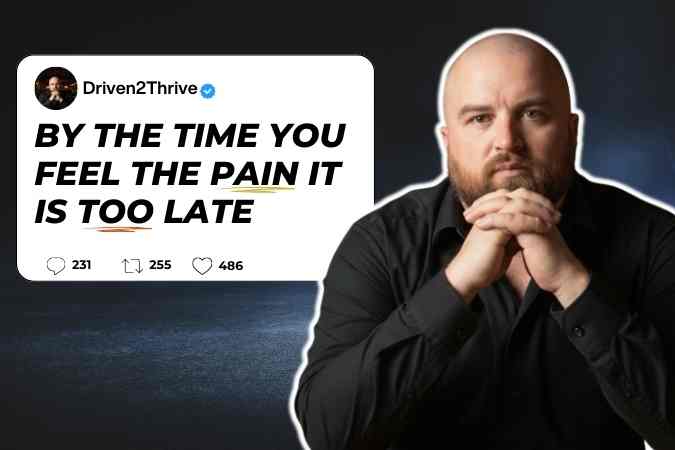
Pain Driven Change: Why Most Men Don’t Grow Until It Hurts
Pain Driven Change explains why most men wait until life becomes unbearable before they finally decide to grow — and how to reprogram that instinct before it damages their marriage, health, or sense of purpose.
From Our Sponsors
A Discount offer from Our Sponsors Mike Lindell and MyPillow for 30 - 80% off your entire purchase and FREE shipping over $75 using Promo Code "THRIVE"! Just use it anything you check out or you can also call call 800-794-5834

Recent Comments